
The American CEO’s Succession Plan
· Gary C. Crisci
Why the disappearance of entry-level jobs is a bet against the future, and the ultimate signal for the next generation to build their own.
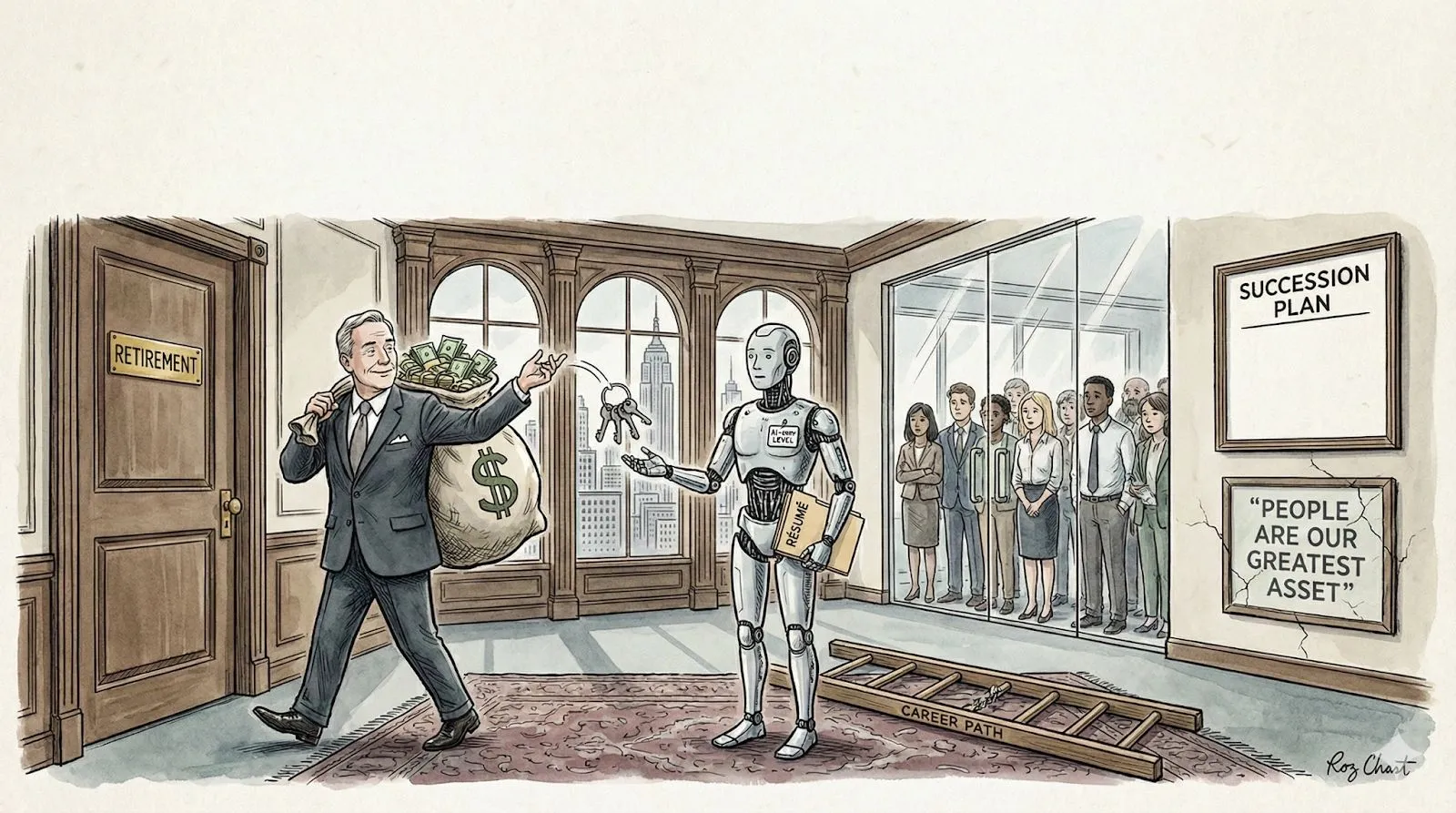
The Short-Term Bet
There is a disturbing trend taking hold in the American C-Suite. It is visible in hiring freezes, hidden in quarterly earnings calls, and felt acutely by the class of 2026. In the age of AI hype, driven by a cocktail of misaligned incentives, short-termism, and external market pressures, many executives are quietly dismantling the corporate ladder.
They are effectively deciding not to hire the next generation.
Recent data confirms what many recent graduates suspect. An analysis of hiring trends by LinkedIn reveals that hiring for entry-level roles has dropped significantly faster than for senior positions over the last year. Furthermore, a ResumeBuilder survey found that a staggering 30% of hiring managers admit to avoiding Gen Z hires entirely, preferring to wait for seniors who “hit the ground running”.
The narrative is convenient: ‘We don’t need entry-level workers because AI can do the grunt work.’ But if you peel back the layers, this isn’t just about technological efficiency. It reflects a dangerous drift away from the concept of the ‘ongoing concern’. By focusing exclusively on slashing costs and automating tasks today, leadership is inadvertently hollowing out the organization’s bench strength. They are dismantling the succession plan and handing the keys over to… well, nobody.”
The View from the Mentor’s Chair
I write this not just as a technologist and executive adviser with 25+ years of experience, but as a father of two college-age children and a mentor to multiple young adults.
I sit across from these students. I see their ambition, their capability, and their anxiety. They are doing everything right; getting the degrees, learning the skills, only to find the doors bolted shut. What they are facing is not just a “tough market.” It is a failure of stewardship.
The Succession Gap
This begs a critical question for every Board of Directors: What is the succession plan?
The foundational role of a CEO is to ensure the “ongoing concern” of the organization - a fiduciary and moral obligation to ensure the company survives after they retire. Yet, we are witnessing a massive abdication of this duty.
If a company stops hiring entry-level talent today, who runs the organization in 10, 15, or 20 years?. You cannot simply 3D-print a seasoned Vice President. Leaders are forged through years of institutional knowledge and cultural assimilation.
By cutting off the pipeline of young talent, CEOs are signaling that they don’t care about the long-term health of the business. They are betting that they can automate the bottom, poach the middle, and exit with their packages before the cultural bill comes due.
If your strategy is “AI and Exit,” you aren’t a leader; you’re a liquidator.
The Strategic Disconnect
The irony of the current hiring freeze is that it actively works against the AI transformation companies claim to seek. While leadership pours capital into technology, they are rejecting the human capital best suited to wield it. Recent graduates are “digital natives” who possess an intuitive adaptability to new interfaces; a critical asset in an AI-enabled workplace.
A forward-thinking leader recognizes that this generation is not a redundancy to be automated; they are the accelerators of the new toolset. By freezing them out, the C-Suite isn’t just cutting costs; they are severing their connection to the very future they are trying to build.
A Call to Stakeholders
This is not a complaint session; it is a reality check for the constituencies that enable this system.
- To the Board of Directors: You are charged with the long-term health of the company. If your CEO has no plan for the next generation of human leaders, they are failing you. You need to ask harder questions.
- To Customers: We vote with our dollars. While price and convenience often drive our decisions, we should not ignore the corporate philosophy we are funding. If a major brand signals that it is prioritizing automation over the next generation of human talent, ask yourself if their vision of the future aligns with the society you want to live in.
- To Employees: Look past the corporate slogans. Leadership often claims that “people are our greatest asset”, but if their actions signal a strategy of “cut and automate”, believe them. Understand that in this environment, loyalty is a strategic error. You must look out for your own future if the company has signaled it will not.
The Pivot: The Weakness of Giants
However, the most important message here is not for the CEOs. It is for the young people they are ignoring.
Big businesses are powerful, yes. But they are also bureaucratic, inefficient, and riddled with technical debt. They are entities optimized strictly for the bottom line. That isn’t an insult; it’s a structural fact. They are shackled by the inertia of their own systemic dysfunction.
This creates a massive opening.
Just as Amazon overtook the sluggish giants of the retail world during the dot com boom, and just as digital photography decimated Kodak, this AI revolution offers a slingshot for the agile.
The New Path Forward
To the young people struggling to find a seat at a corporate table that no longer wants you: Don’t sit there.
The era of relying on a corporation to be your savior is ending. The dream shouldn’t be to become a cog in a machine that views you as a liability.
- Leverage Your Network: Gather your friends, your classmates, and your creative circles. Find complementary skills.
- Use the Tools: You have access to the same enterprise-grade AI technology that the Fortune 500 has. But unlike them, you don’t have three layers of middle management approving every prompt.
- Build Your Own: Small and medium-sized businesses can now punch way above their weight. You can provide better service, better quality, and a better culture than the incumbents.
There is enough space in the market to build a meaningful life, earn a good living, and secure your own future without waiting for permission from a CEO looking for a quick exit.
Let the “titans of industry” ride off into the sunset with their bags of money. The future belongs to those who build it.
Go get it!