
The Illusion of Cheaper Software: How Generative AI Inverts the Build-vs-Buy Equation
· Gary C. Crisci
Executive Summary
For decades, the strategic choice between building custom software and buying commercial off-the-shelf (COTS) platforms followed a predictable financial model. “Buying” delivered rapid deployment and predictable licensing or subscription fees, while “Building” demanded steep upfront capital in exchange for tailored capabilities and unique intellectual property.
The mainstream adoption of advanced AI coding assistants like Claude Code, GitHub Copilot, and automated agents has fundamentally disrupted this calculation. By automating boilerplate code, unit testing, and rapid prototyping, AI has plummeted initial development costs by 30% to 50%.
However, this upfront discount introduces a dangerous economic paradox. The ease of code generation is fueling an unprecedented explosion of code volume, leading to severe architectural drift, fragmented application portfolios, escalating shadow IT, and severe compliance risks. Far from making custom software universally “cheap,” generative AI has back-loaded the Total Cost of Ownership (TCO).
Concurrently, a new competitive breed of “AI-First” Niche Vendors has emerged. By leveraging AI internally to compress their own engineering cycles while embedding domain expertise, these hyper-specialized providers offer a compelling third path: the agility and cost-efficiency of an AI build, backed by the structural safety, liability transfer, and collective best practices of a traditional commercial platform.
The Upfront Economic Shift: Redefining the Build Phase
In the pre-AI era, software engineering budgets were explicitly driven by human labor hours. Developing a complex, multi-region enterprise application typically required an upfront investment ranging from $100,000 to $750,000+, with deeply integrated or highly regulated systems frequently exceeding $1.5 million.
AI tools have fundamentally compressed these timelines. What used to take months of engineering sprints can now be achieved in weeks or even days through natural language prompts and automated execution.
The Rise of “Juniorization”
The financial appeal of AI development lies primarily in labor optimization. Senior engineers become force multipliers, while junior developers—or even non-technical business analysts—can leverage AI to output functional code bases rapidly. This lowers the immediate payroll run-rate required to reach a Minimum Viable Product (MVP), creating the illusion of a highly cost-effective build.
The Hidden Multipliers: Why “Code is a Liability”
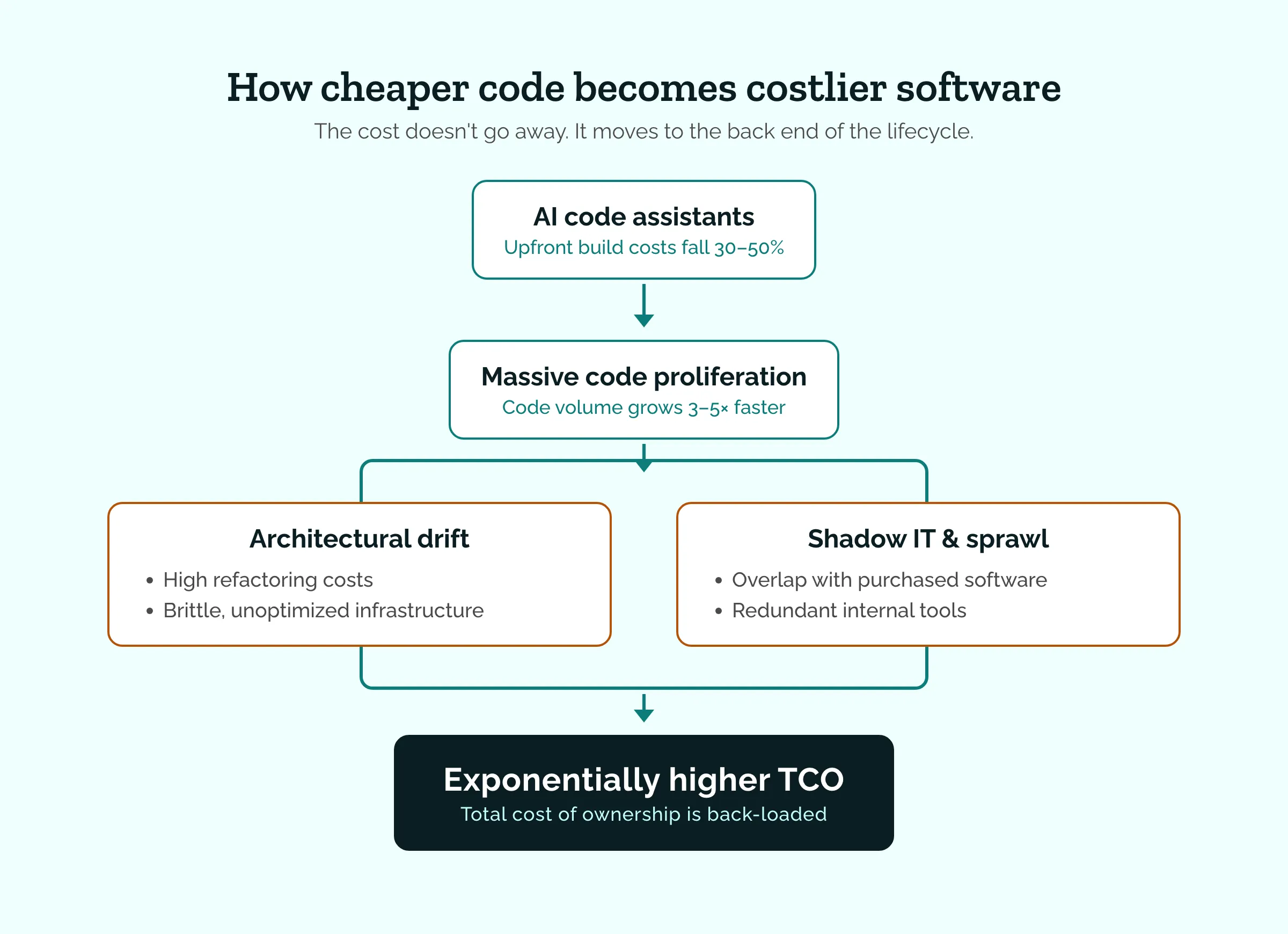
While the cost to generate code has neared zero, the cost to maintain code has risen exponentially. In standard software economics, annual maintenance, security compliance, and hosting consume roughly 15% to 20% of the original build cost. In the AI era, this linear relationship is broken due to six core systemic issues:
1. Code Proliferation and the Debugging Premium
AI assistants make it effortless to generate thousands of lines of code. However, engineering teams are discovering that because code volume scales 3x to 5x faster, the surface area for bugs, edge-case failures, and security vulnerabilities expands at the same rate. Reading, validating, and debugging AI-generated code requires deeper cognitive effort than maintaining human-written code, resulting in a premium on senior engineering hours to resolve complex production issues.
2. Architectural Drift
AI tools are highly effective at solving localized, isolated programming tasks. They are fundamentally deficient, however, at understanding the holistic, long-term architectural patterns of a massive enterprise ecosystem. Without rigorous manual oversight, AI-generated applications quickly suffer from structural decay, resulting in brittle data models, unoptimized database queries, and volatile infrastructure scaling that drives up cloud hosting and observability bills.
3. The Cyber & Compliance Penalty: Transferred vs. Fabricated Risk
The hidden operational cost of AI code generation is the introduction of systemic digital risk. In a traditional “Buy” scenario, an enterprise pays a premium to transfer liability. Established software vendors invest millions annually to maintain compliance frameworks (such as GDPR, HIPAA, or SOC2), patch zero-day exploits, and build security into their products.
When leveraging AI to “Build,” the enterprise assumes 100% of the risk profile. AI assistants are trained to optimize for syntactic validity—making code that runs—rather than cryptographic security or compliance protocols. Automated code generation often utilizes outdated public repository patterns, accidentally reinventing known security vulnerabilities or introducing malicious, hallucinated open-source packages. Furthermore, AI models cannot sign a Business Associate Agreement (BAA) or absorb legal blame when a breach occurs.
4. The Domain Expertise Deficit: Reinventing the Operational Wheel
The fundamental question every technology leader must ask before initiating an AI-driven custom build is: Is our organization a software company, and does this specific workflow provide a distinct competitive advantage?
There is zero strategic differentiation in how a firm runs its internal payroll, processes generic accounts payable, or closes its balance sheet. These are commodity business processes governed by universal compliance standards.
When an enterprise purchases a specialized, niche commercial solution, it inherits institutional best practices. Software vendors survive by continuously optimizing their products based on the collective friction points, regulatory shifts, and operational nuances experienced across their entire customer base. A custom internal build—even one accelerated by AI—is entirely insular. It forces an engineering team to manually solve edge cases, exception workflows, and audit requirements that specialized vendors figured out and standardized a decade ago.
5. The Illusion of Competence: “Confidently Wrong” Architecture
Proponents of AI development argue that large language models can simply replicate these best practices because they have been trained on vast repositories of enterprise documentation and open-source code bases. This argument overlooks the inherent engineering risk of confident hallucination.
AI code assistants are optimized to produce syntactically correct logic that satisfies the prompt, not necessarily logic that is business-accurate or institutionally sound. Because the generated code looks highly professional on the surface, internal developers often lack the deep domain expertise required to spot subtle logical gaps or edge-case failures during review. The organization ultimately deploys a system that is “confidently wrong,” only discovering the structural defect when it fails a formal regulatory audit or triggers a critical reporting error.
6. Application Portfolio Management (APM) and Shadow IT Chaos
Because the barrier to software creation has been lowered, individual business units no longer need to wait for centralized IT approval. They can use AI to build custom, isolated internal tools. This creates an APM nightmare characterized by redundant systems across departments, massive data fragmentation, and unvetted applications operating entirely outside enterprise security frameworks.
The Three-Way Build-vs-Buy-vs-Niche Framework
The strategic choice is no longer a binary toss-up between traditional slow-moving vendors and high-risk internal AI builds. A third viable alternative has emerged: AI-First Niche Vendors. These are agile, domain-specific independent software companies that build using automated AI factories internally, allowing them to pass massive speed and cost advantages to the client without sacrificing structural guardrails or collective domain expertise.
| Cost, Risk, & Operational Element | Traditional Software Vendor | Build Your Own (AI-Assisted) | Next-Gen AI-First Niche Vendor |
|---|---|---|---|
| Upfront Cost / Implementation Fee | 🔴 High (Rigid onboarding and overhead) | 🟢 Very Low (Rapid internal generation) | 🟢 Low (AI-driven deployment automation) |
| Speed to Deployment | 🔴 Slow (Months to years of manual sprints) | 🟢 Instantaneous (Rapid MVPs in days) | 🟢 Fast (Pre-built core customized via AI) |
| Architecture & Design Guardrails | 🟢 Rigid (Vendor-enforced standards) | 🔴 Very High Risk (Severe internal drift) | 🟢 High (Enforced by vendor’s core product) |
| 5-Year Maintenance Profile | 🟡 Linear (Predictable annual license/support) | 🔴 Exponential (High refactoring overhead) | 🟡 Linear (Vendor offloads technical debt) |
| Portfolio Control (APM) | 🟢 Controlled (Centralized procurement) | 🔴 Chaotic (Explosion of Shadow IT sprawl) | 🟢 Controlled (Managed as a single asset) |
| Cybersecurity Vulnerability | 🟢 Vetted (Continuous enterprise patching) | 🔴 Extreme (Hidden bugs & insecure patterns) | 🟢 Vetted (Core product security guaranteed) |
| Regulatory Compliance & Liability | 🟢 Transferred (Vendor signs BAAs / SOC2) | 🔴 High Risk (Internal team assumes 100% risk) | 🟢 Transferred (Vendor backed compliance) |
| Domain Expertise & Best Practices | 🟢 Inherent (Built on industry aggregates) | 🔴 Deficient (Reinvents wheel; confidently wrong) | 🟢 Inherent (Built on narrow domain expertise) |
Strategic Verdict and Recommendations
AI has permanently shattered the legacy assumption that a lower cost to code equals a cheaper software asset. In this hyper-automated landscape, the role of the technology executive must pivot from managing software delivery to managing systemic software risk. Writing code is no longer the bottleneck; governing it is.
To successfully navigate this new economic reality, technology leaders must implement a revised framework for software procurement:
- Classify Core vs. Commodity: If an application represents a core business differentiator or unique intellectual property, leverage AI to build it custom—but reallocate 30% to 50% of the financial savings directly into senior enterprise architects, cybersecurity engineers, and automated code-review guardrails.
- Target AI-First Niche Vendors for Specialized Scale: For complex but non-differentiating operations—such as balance sheet reconciliation, specialized logistics, or niche treasury management—bypass both traditional legacy suites and custom AI builds. Partner with next-generation, AI-first niche vendors. This captures the aggressive pricing and deployment speed of an AI model while inheriting the domain expertise and liability transfer of an established software house.
- Establish Automated APM Gateways: Implement strict, centralized infrastructure gates to prevent business units from deploying unmonitored AI-built applications to production environments without formal IT and security compliance sign-offs. If you cannot afford to govern the code, you cannot afford to let AI generate it.
Generative AI provides unprecedented leverage to create software, but it demands an equally unprecedented discipline to govern it. The organizations that win the next decade will not be those that generate the most code the fastest, but those that establish the tightest structural, security, and portfolio discipline around their software ecosystem.